Originally written: 3/14/2012; last Web page update: 3/13/2020, referencing rEFInd 0.12.0
This Web page is provided free of charge and with no annoying outside ads; however, I did take time to prepare it, and Web hosting does cost money. If you find this Web page useful, please consider making a small donation to help keep this site up and running. Thanks!
| Donate $1.00 | Donate $2.50 | Donate $5.00 | Donate $10.00 | Donate $20.00 | Donate another value |
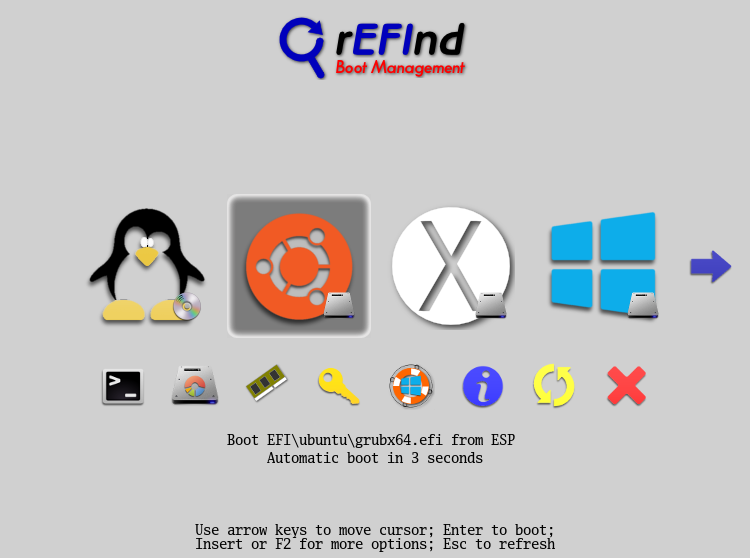
This page describes rEFInd, my fork of the rEFIt boot manager for computers based on the Extensible Firmware Interface (EFI) and Unified EFI (UEFI). Like rEFIt, rEFInd is a boot manager, meaning that it presents a menu of options to the user when the computer first starts up, as shown below. rEFInd is not a boot loader, which is a program that loads an OS kernel and hands off control to it. (Since version 3.3.0, the Linux kernel has included a built-in boot loader, though, so this distinction is rather artificial these days, at least for Linux.) Many popular boot managers, such as the Grand Unified Bootloader (GRUB), are also boot loaders, which can blur the distinction in many users' minds. All EFI-capable OSes include boot loaders, so this limitation isn't a problem. If you're using Linux, you should be aware that several EFI boot loaders are available, so choosing between them can be a challenge. In fact, the Linux kernel can function as an EFI boot loader for itself, which gives rEFInd characteristics similar to a boot loader for Linux. See my Web page on this topic for more information.
Many people use their Facebook credentials to log in to other websites and apps (OAuth), meaning a single compromise can lead to a cascade of security breaches across multiple platforms. Protecting Your Online Identity
Always verify the authenticity of emails or messages asking for your login credentials. Facebook will never ask for your password via email. Conclusion
The existence of searchable "password indexes" is a stark reminder of the persistent threats in the digital landscape. By understanding the techniques used by attackers and implementing proactive security measures, you can significantly reduce the risk of your personal information falling into the wrong hands. index of user password facebook filetype txt extra quality
If these files are uploaded to misconfigured servers, search engines may index them. A specific search query like filetype:txt combined with keywords like "password" and "Facebook" is a common technique used to locate these files.
Finding your information in such a file is a serious security event. To protect yourself, consider the following best practices: Many people use their Facebook credentials to log
Facebook accounts are highly sought after by cybercriminals for several reasons:
Never reuse passwords across different services. A password manager can help you generate and store complex passwords for every account. Conclusion The existence of searchable "password indexes" is
The search term in question points to a dangerous intersection of data breaches and open-source intelligence (OSINT). When hackers breach a service, they often dump the stolen data into text files, which can then be indexed by search engines if not properly secured.
copyright © 2012–2020 by Roderick W. Smith
This document is licensed under the terms of the GNU Free Documentation License (FDL), version 1.3.
If you have problems with or comments about this Web page, please e-mail me at Thanks.
Return to my main Web page.