Overtone
Hot Mallu Midnight Masala Mallu Aunty Romance Scene 13 Patched [2021] ⟶
One cannot discuss Malayalam cinema without acknowledging its symbiotic relationship with literature. Many legendary films are adaptations of works by literary giants like Vaikom Muhammad Basheer, M.T. Vasudevan Nair, and Thakazhi Sivasankara Pillai. This literary backbone ensures that even "mass" entertainers often possess a level of thematic depth and character development rarely seen elsewhere. The emphasis is always on the thira-katha (screenplay), which remains the undisputed king of the production process. Socio-Political Commentary
Malayalam cinema, often referred to as Mollywood, is not just a film industry; it is a profound reflection of the social, political, and cultural fabric of Kerala. Unlike many other Indian film industries that lean heavily on grandiosity and escapism, Malayalam cinema has carved a niche for itself through realism, intricate storytelling, and a deep-rooted connection to the land’s intellectual heritage. The Realistic Aesthetic This literary backbone ensures that even "mass" entertainers
At the heart of Malayalam cinema lies a commitment to hyper-realism. Since the 1970s and 80s—often called the "Golden Age"—filmmakers like Aravindan, Adoor Gopalakrishnan, and P. Padmarajan moved away from studio-bound sets to the lush, rain-soaked landscapes of rural Kerala. This shift brought the "common man" to the forefront. The stories often revolve around middle-class anxieties, feudal breakdowns, and the nuances of family life, making the medium a mirror to the Malayali identity. Literature and Scriptwriting Unlike many other Indian film industries that lean
Despite having smaller budgets compared to Bollywood or Telugu cinema, Mollywood is a pioneer in technical innovation. Whether it is cinematography, sound design, or editing, the industry punches well above its weight. The recent "New Gen" movement has embraced digital platforms, allowing films like Jallikattu or Minnal Murali to find a global audience on streaming services, proving that local stories, when told with authenticity, have universal appeal. challenges the status quo
While the industry boasts global icons like Mammootty and Mohanlal, their stardom is unique. Both actors built their legacies on "acting-first" principles, often portraying flawed, vulnerable, or even antagonistic characters at the height of their fame. This tradition continues with the new generation—Fahadh Faasil, Parvathy Thiruvothu, and Prithviraj—who prioritize experimental narratives and "New Wave" aesthetics over traditional hero tropes. Technical Brilliance and Global Reach
Kerala’s high literacy rate and political consciousness are vividly captured on celluloid. Malayalam films frequently tackle sensitive subjects, including caste hierarchy, religious harmony, labor movements, and gender roles. Films like Sandesham used satire to critique blind political allegiance, while modern masterpieces like The Great Indian Kitchen have sparked nationwide conversations about patriarchy and domestic labor. The Evolution of Superstardom
Malayalam cinema remains a testament to the power of grounded storytelling. It celebrates the mundane, challenges the status quo, and continues to evolve without losing its soulful connection to Kerala's rich cultural heritage.
Examples
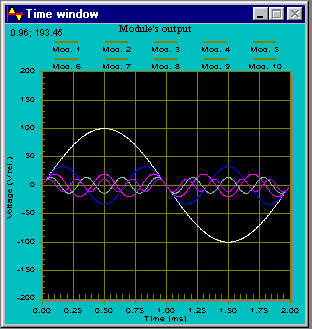
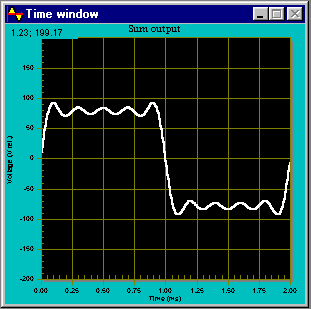
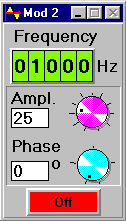
You can test the Helmholtz assumption that the relative phases of the overtones are irrelevant to hearing.
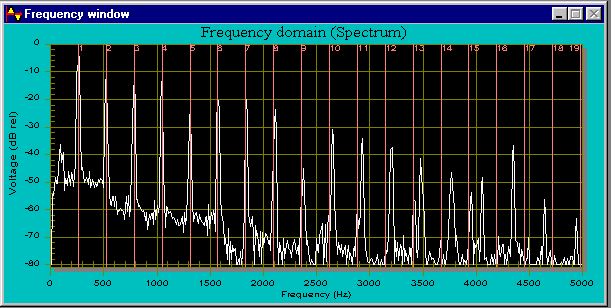
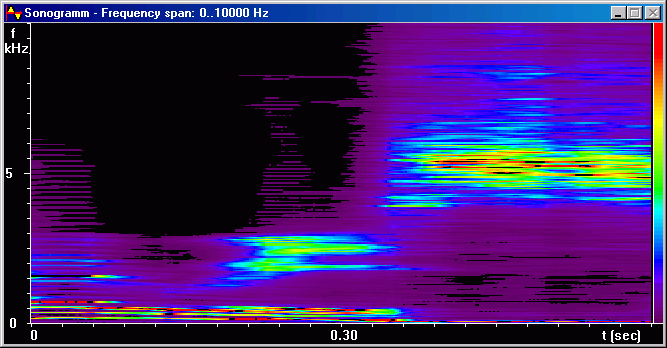
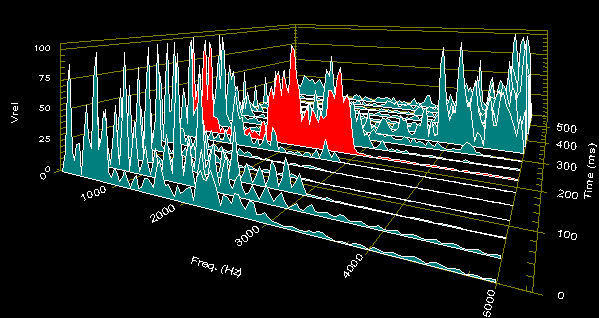
In analyser experiments you capture sound from the sound card or from a WAV file up to several seconds long, select the starting time of the time slice and analyse time and frequency responses. The example shows the spectrum of a piano playing a middle C (262 Hz). The non-harmonic overtones are clearly seen. (Due to the stiffness of the string, the frequencies of the partials are too high.)
Download version 1.15, June 2009: OVERTONE.ZIP
(1.55 MB)
Unpack in a new folder, read README.TXT and start OVERTONE.EXE
(Some firewalls or User Access Control (UAC) may block execution. Give OVERTONE the necessary permissions.
Make sure, that the sound device is not used by another application.)
For more information, send e-mail to address given in README.TXT
Unterrichtseinheit Analyse von Klangspektren von Alain Hauser (in German)
